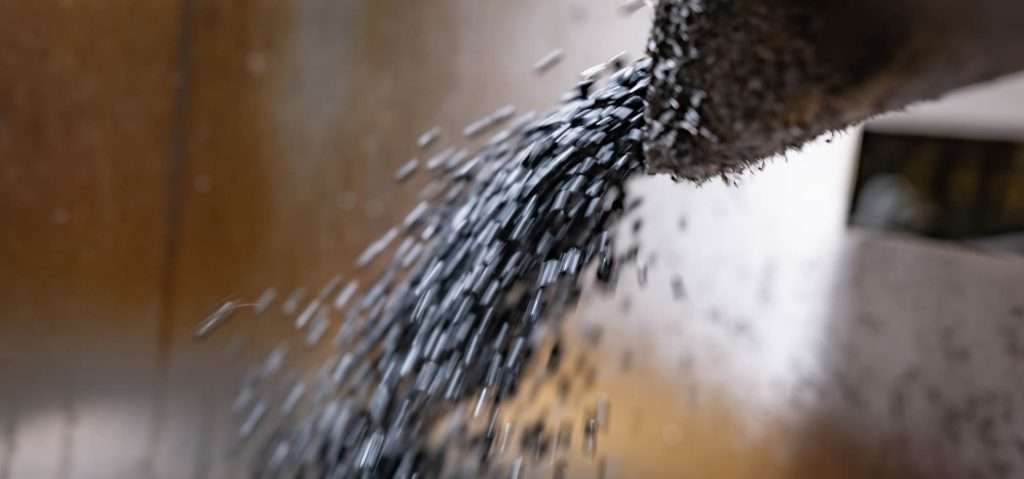
We supply recycled polypropylene and high density polyethylene as pellets and custom compounds to moulders, extruders and converters across packaging, automotive, horticulture and general manufacturing. We source our feedstock in the UK wherever possible, and we can tailor grades to the performance and colour your product needs.
Recycled PP: stiff, light and heat tolerant
Recycled polypropylene suits parts that need to stay rigid, keep their weight down and stand up to heat and chemicals. It keeps the strength and resilience that make PP one of the most widely used polymers in manufacturing.
Our PP pellets and compounds can be tailored for colour, melt flow index and other properties, and every batch is tested for uniformity. That means the material behaves the same way on your machines from one delivery to the next.
Where recycled PP performs well:
- Automotive: interior and exterior parts that need strength and heat resistance
- Industrial products: crates, pallets and piping systems
- Consumer goods: furniture, storage containers and parts for household appliances
- Packaging: caps, closures and industrial packaging
- Horticulture: pots, trays and garden products
Recycled HDPE: tough, chemical resistant and built for the outdoors
Recycled high density polyethylene is the choice for products that take knocks, carry liquids or live outside. HDPE resists impact, chemicals and weathering, which is why it turns up in so many hard working products.
Our HDPE pellets can be tailored for colour, density and melt flow rate, and they are tested for quality and uniformity so they run consistently in production.
Where recycled HDPE performs well:
- Industrial: crates, pallets, pipes and ducting
- Consumer goods: garden furniture, bins and other durable goods
- Packaging: bottles, caps and containers for household and industrial products
- Moulding: injection and blow moulded parts
PP or HDPE: a quick guide
| Recycled PP | Recycled HDPE | |
| Best known for | Stiffness, low weight, heat resistance | Impact strength, chemical and weather resistance |
| Typical products | Automotive parts, crates, storage, closures | Bins, pipes, garden furniture, containers |
| Can be tailored for | Colour, melt flow index | Colour, density, melt flow rate |
What it means for your business
Recycled content now affects your tax bill, your customers’ buying decisions and your carbon reporting. Our PP and HDPE gives you a practical way to act on all three.
Lower Plastic Packaging Tax exposure. Plastic packaging components made in or imported into the UK with less than 30% recycled plastic are taxed at £228.82 per tonne from 1 April 2026 (GOV.UK). Reaching 30% recycled content with our pellets, where recycled plastic is permitted for that use, takes those components out of the charge. Registration and record keeping still apply above the 10 tonne threshold, so ask us about the information your records need.
Lower carbon material. A life cycle assessment of our recycled PP and HDPE pellets, carried out with the University of Sheffield to ISO 14040 on a gate to gate basis, found emission factors significantly lower than DEFRA’s published figures for closed loop plastics (University of Sheffield). That gives you evidence to support your own carbon reporting.
Customer and tender requirements. Retailers, brand owners and public sector buyers increasingly write recycled content into their specifications and tenders. Our material helps you meet those requirements with a UK supplier.
A UK supply chain. Our pellets are made in Castleford, West Yorkshire, and we keep material in the UK wherever possible. Buying from a UK recycler shortens your supply chain and keeps the value of UK plastic in UK manufacturing.Putting recycled content into your products
The simplest route is to start with one product, agree the grade and prove it on your own machines.
- Start with the part. Tell us what it does, how you make it (injection moulding, extrusion or blow moulding) and what it must pass, from impact strength to stiffness.
- Agree the grade. We match a standard grade or tailor a compound for melt flow, density and colour.
- Set your colour early. Colour is easiest to manage when it is agreed at the start, so share your target shade with us early.
- Trial, then scale. Run a trial on your own equipment before committing to full volume. Many manufacturers start with a blend alongside virgin polymer and increase the recycled share as confidence builds.
- Plan supply. Agree volumes and delivery with our commercial team so production planning stays straightforward.
Our Technical and Quality Manager, Jonathan Attwood, and his team can talk through specification and testing with you at any stage.
Talk to us about your next product
If you mould, extrude or convert PP or HDPE, we would like to hear what you are making. Contact our sales team at casd.sales@iplglobal.com to discuss grades, volumes and trials, or get in touch through our website.